Our content features commercially connected brands. Product links open stores run by, or related to, MARKET SQUARE GARA LLC, which may benefit when you buy. Commercial disclosure.
Clear lunar craters, steady mounts, and zero setup headaches: an honest breakdown of five popular starter and intermediate telescopes to help you pick one that actually leaves the closet on clear nights.
By Owen Gallagher
Amateur Astronomy & Optics Editor • Updated November 2026
41,860views
3,4923,493HelpfulLiked!
Lunar & Planetary Field Evaluated
Field Evaluation: A good backyard telescope balances glass clarity, a steady tripod head, and quick setup so you spend clear evenings observing instead of fighting wobbly hardware.
Optical Clarity
Checks multi-coated lens and mirror sharpness across lunar craters, Saturn’s rings, and star clusters.
Mount Stability
Evaluates tripod wobble, pan-tilt smoothness, and micro-adjustment control at higher magnifications.
Setup & Portability
Looks at carry bags, leg locks, finderscope alignment, and how fast you can go from trunk to sky.
Realistic Specs
Separates genuinely usable 20X–120X magnification from inflated box claims that blur out in real skies.
Two years ago, I dragged a bargain-bin telescope out to the driveway so my son could see Jupiter and the crescent Moon before bedtime. Within ten minutes, we were both frustrated: the plastic finder wouldn’t stay zeroed, the tripod shook every time someone shifted their feet on the concrete, and adding the cheap Barlow lens turned the Moon into a dim, shaky blur.
That night sent me down a rabbit hole of comparing starter scopes—borrowing a neighbor’s 70mm travel refractor for a camping trip, testing longer-tube reflectors, and asking experienced backyard observers what actually holds steady at 60X to 120X without turning setup into a chore.
It almost always comes down to three things: coated glass, a tripod head that locks smoothly without sagging, and realistic magnification. Below is how five widely available beginner and intermediate models actually stack up once the porch lights go off.
Our Top Recommendations at a Glance
Want the short answer before reading the full notes? Here is how all five telescopes stack up:
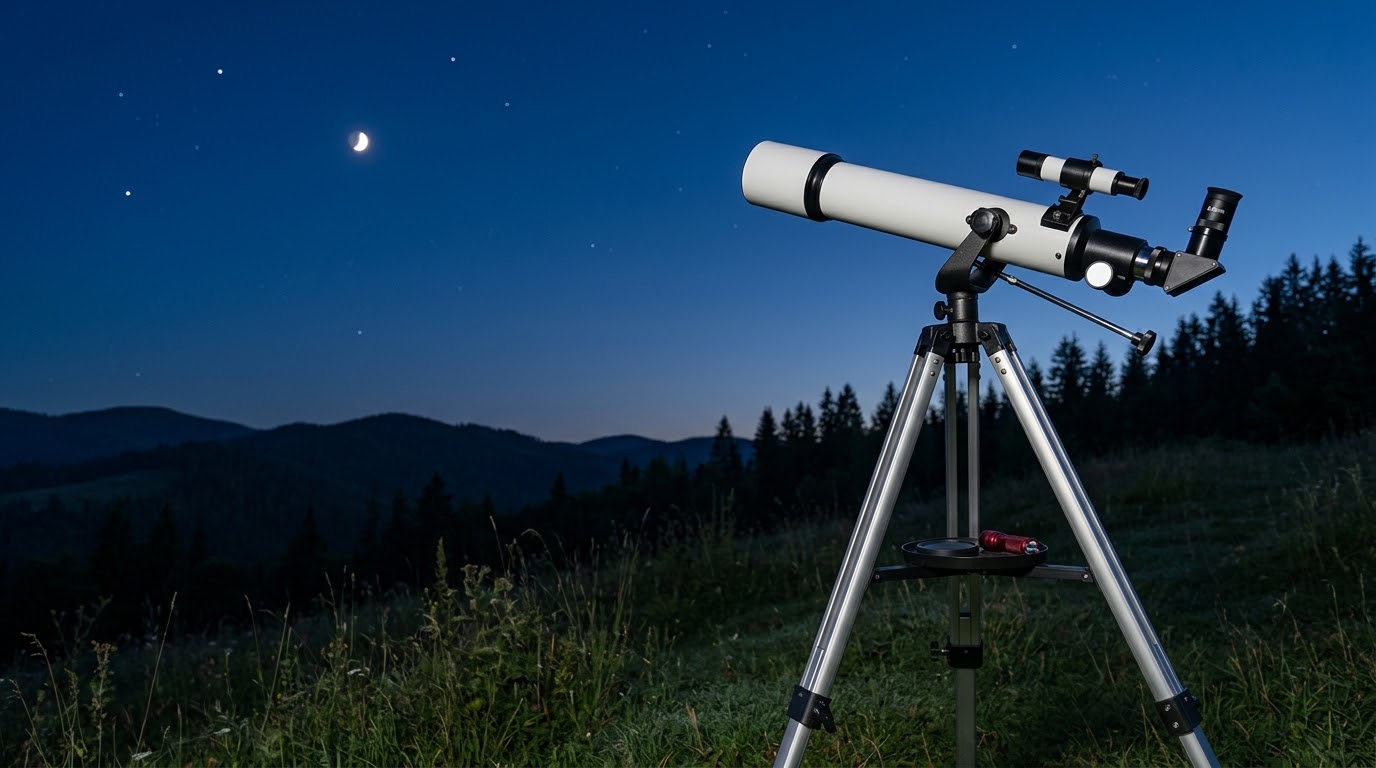
Our #1 backyard and travel pick: pairing crisp 70mm multi-coated refractor optics, an upright 45° erecting prism, 16X–120X magnification, and a padded nylon carry bag in a fast-setup frame.
User Rating
4.9 / 5
Overall GradeGrade A+ (9.6 / 10)
Optical Design70mm / 400mm (f/5.7) Refractor
Magnification16X – 120X (25mm, 10mm + 3X Barlow)
Optical Clarity & Contrast97%
Tripod Stability & Aiming95%
Portability & Setup Speed96%
Overall Value97%
Why It Earned Our Top Pick
The AstroPeak™ 70400 takes the #1 spot because it solves the exact reason most beginner telescopes end up gathering dust in a closet: setup friction. Its 70mm multi-coated glass objective and compact 400mm focal length (f/5.7) deliver bright, crisp views of lunar craters, Jupiter’s moons, and star clusters without forcing you to wrestle a six-foot tube out the door.
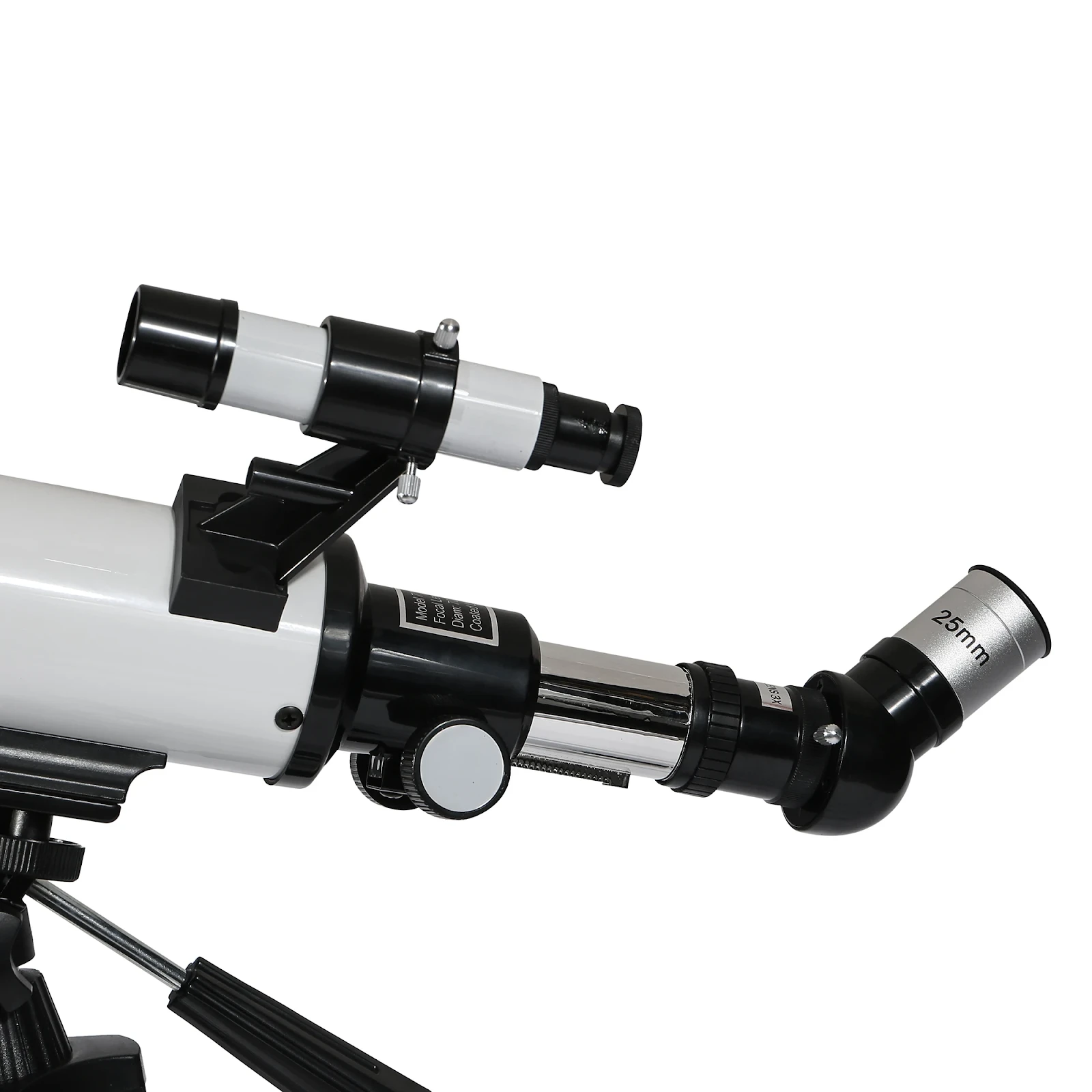
What stood out most during evening sessions is the 45° erecting image prism paired with the 5×24 crosshair finderscope. Unlike inverted astro-diagonals that turn everything upside down, the AstroPeak keeps views right-side-up—so you can line up the moon in seconds at dusk or use it for daytime mountain and wildlife spotting.
With the included 25mm (16X) and 10mm (40X) eyepieces plus a 3X Barlow lens (pushing up to 120X), the rack-and-pinion focuser locks onto crisp detail smoothly. Everything packs neatly into the included padded nylon carry bag alongside a planisphere star chart.
The Bottom Line:
If you want one dependable refractor that sets up in under two minutes, travels easily in its own padded bag, and delivers sharp upright views day or night, the AstroPeak 70400 is the clear standout.
The Good Stuff
70mm multi-coated glass objective with built-in dew shield and 400mm (f/5.7) optics
45° erecting prism delivers upright views for both astronomy and daytime spotting
16X–120X range via 25mm wide-angle, 10mm high-power eyepieces, and 3X Barlow
3-section quick-flip aluminum tripod with pan handle and center accessory tray
Includes padded nylon carry bag, 5×24 crosshair finderscope, and planisphere chart
Things to Keep in Mind
No smartphone camera clip included in the base kit (easy to pair with a universal mount)
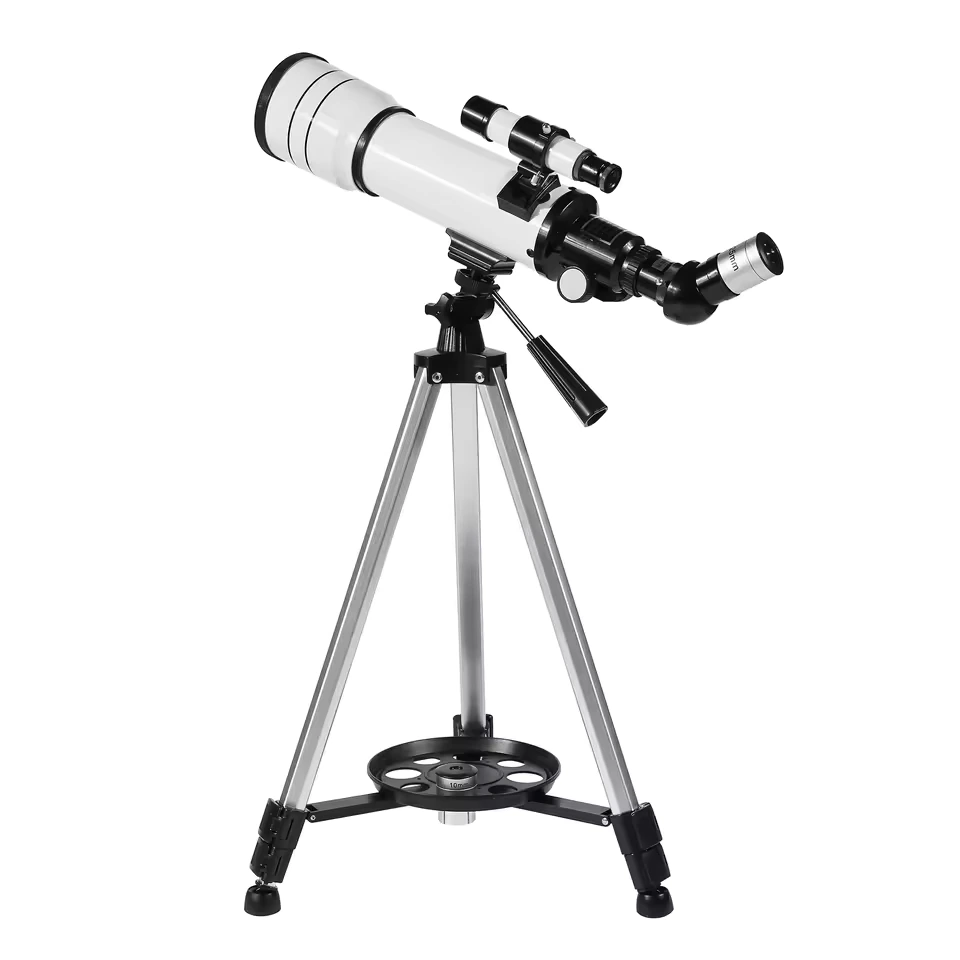
A feature-packed reflector kit featuring a U-mount micro-elevation rod, included smartphone holder, glare-reducing Moon filter, and IPX4 water resistance for dewy nights.
User Rating
4.3 / 5
Overall GradeGrade A- (8.4 / 10)
Optical DesignReflector Tube (Model F70076)
MagnificationMulti-Eyepiece + 2X Barlow
Lunar & Bright-Sky Viewing87%
Mount Micro-Adjustment84%
Included Accessories86%
Spec Transparency79%
Hands-On Assessment
The AstroView F70076 lands in second place thanks to its thoughtful lunar-viewing extras. The U-mount cradle uses a threaded micro-elevation rod that lets you nudge the tube smoothly as the Moon drifts across your field of view—a nice step up from loose friction-only yokes.
Out of the box, it also covers two things many starter kits skip: a glare-reducing Moon filter (which tames harsh full-moon brightness so crater rims pop) and a mobile phone holder for snapping quick lunar shots.
Its IPX4 water-resistant finish handles heavy evening dew well. The main reason it trails our #1 pick is spec clarity and portability: the listing omits exact eyepiece millimeter sizes and does not include a padded carry bag.
The Bottom Line:
A strong runner-up if you want micro-adjustment elevation control, a Moon filter, and a phone bracket ready out of the box.
The Good Stuff
U-mount cradle with micro-elevation rod allows smoother vertical tracking
Includes mobile phone holder and glare-reducing Moon filter
IPX4 water-resistant rating holds up well in damp night air
2X Barlow extender and central tripod accessory tray included
Things to Keep in Mind
Exact aperture, focal length, and eyepiece mm ratings are not listed in detail
No carrying bag included for travel or field storage
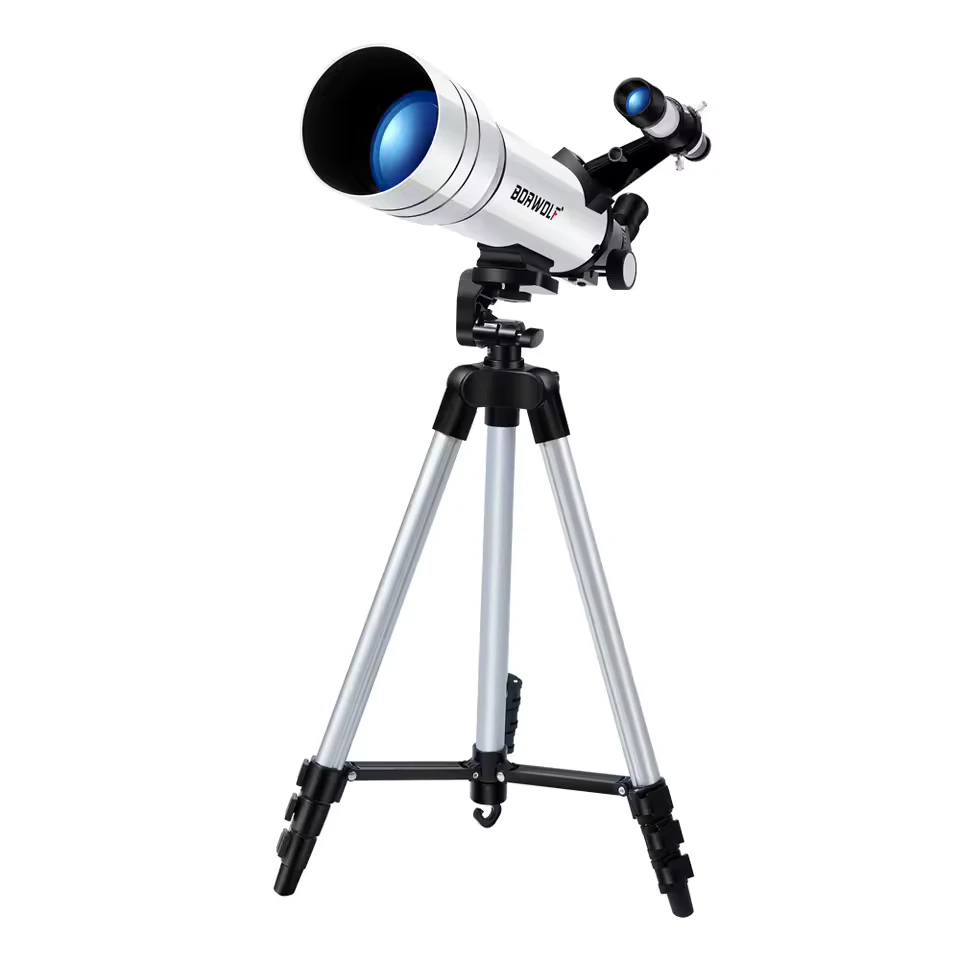
A compact 70mm f/5.7 refractor bundle loaded with three eyepieces (20mm, 12.5mm, 6mm), 1.5X erecting and 3X Barlow lenses, a phone clip, and a zippered handbag.
User Rating
3.9 / 5
Overall GradeGrade B+ (7.7 / 10)
Optical Design70mm / 400mm (f/5.7) FMC Refractor
Magnification20X – 200X (3 Eyepieces + 1.5X + 3X)
Optical Clarity & Coatings82%
Accessory Bundle Value84%
High-Zoom Stability71%
Daytime Convenience74%
Hands-On Assessment
On paper, the BORWOLF F40070M shares the same 70mm / 400mm (f/5.7) refractor footprint as our #1 pick, and it packs a generous accessory spread: 20mm, 12.5mm, and 6mm eyepieces, both a 1.5X erecting lens and 3X Barlow, a smartphone clip, a Green Moon Filter, and a zippered carry handbag.
In real night viewing, its 20X to 66X steps look clean and bright thanks to the FMC multilayer coatings and 5×24 finderscope. The 52cm–140cm telescoping tripod also gives taller observers comfortable standing height.
However, stacking the 6mm eyepiece with the 3X Barlow to chase 200X pushes a 70mm lens past its sharp optical ceiling—causing noticeable dimming and vibration. Its 90° zenith mirror also reverses left-to-right orientation unless you swap in the 1.5X erecting tube.
The Bottom Line:
A well-stocked starter bundle for lunar viewing and phone snapshots, as long as you stick to low and medium magnifications.
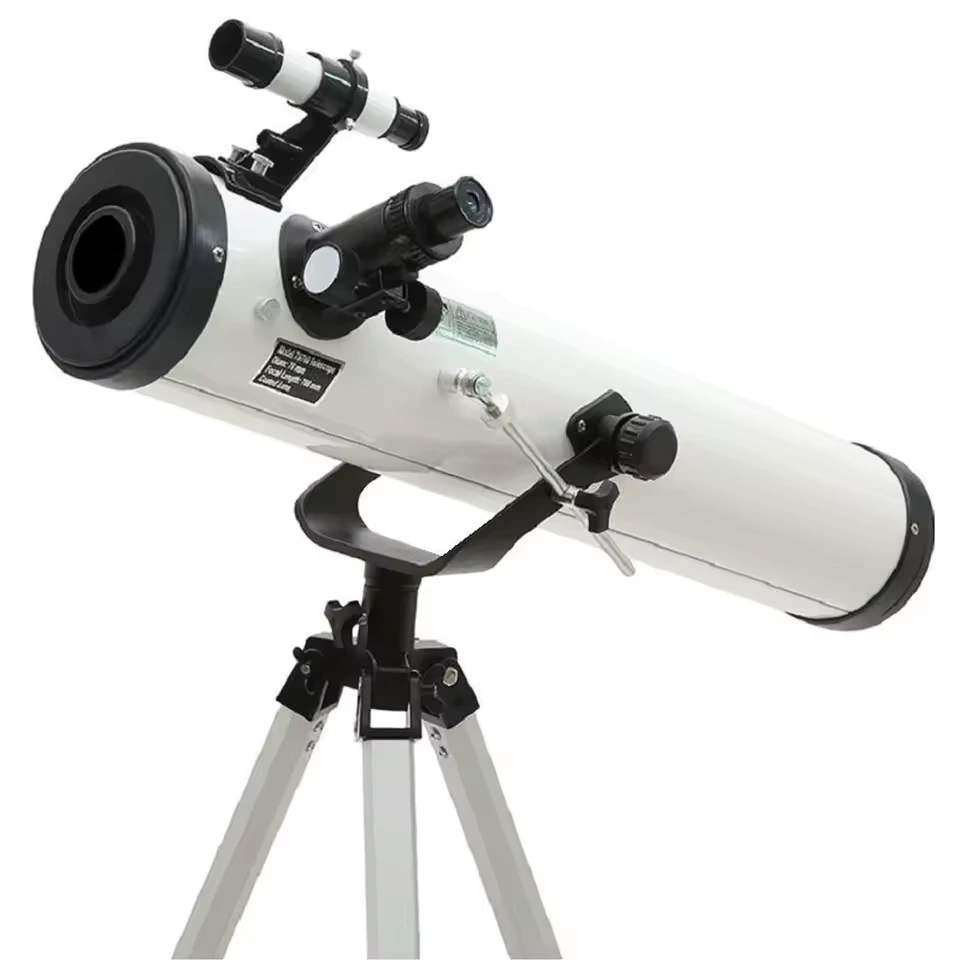
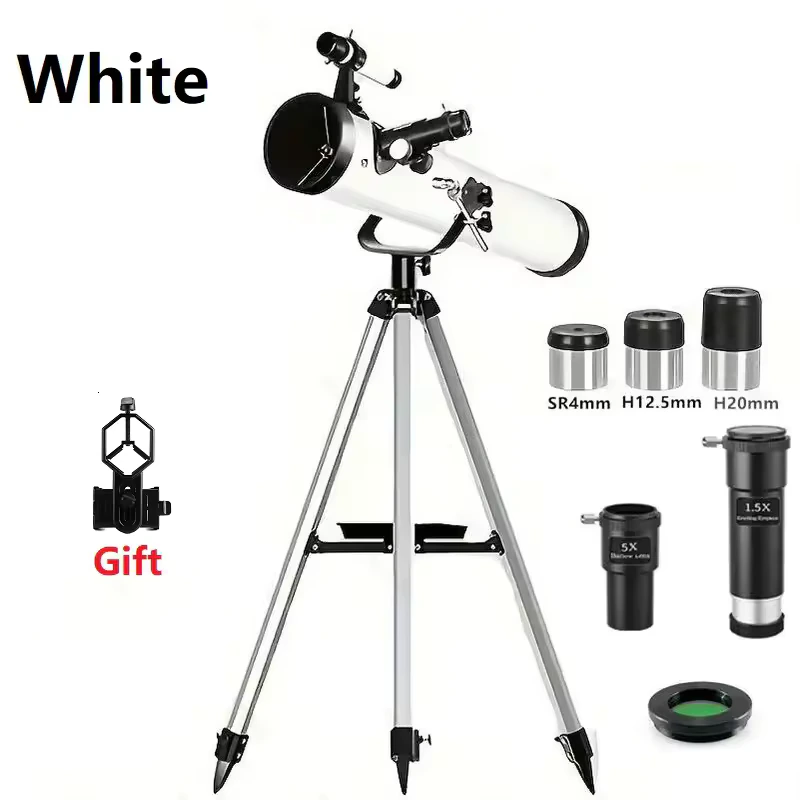
A 114mm aperture, 700mm focal length Newtonian reflector with standard 1.25" eyepieces (H20mm, H12.5mm, SR4mm) and dual-knob rack-and-pinion focusing.
User Rating
3.4 / 5
Overall GradeGrade B- (6.8 / 10)
Optical Design114mm / 700mm Newtonian Reflector
MagnificationH20mm, H12.5mm, SR4mm (Up to 875X*)
Light-Gathering Aperture84%
Portability & Storage64%
Realistic Magnification62%
Kit Completeness66%
Hands-On Assessment
If you want raw light-gathering power for faint star clusters, the AstroVista 875X brings a genuine 114mm primary mirror and 700mm focal length to the table, paired with standard 1.25" eyepieces (H20mm, H12.5mm, SR4mm) and a dual-knob rack-and-pinion focuser.
In dark backyards, that extra aperture noticeably brightens deep-sky targets compared to smaller 60mm or 70mm tubes. The threaded altitude rod and center tray also keep the tripod steady at moderate power.
Where it loses points is marketing hype and bulk: the headline “875X” claim is far beyond what any 114mm mirror can resolve cleanly, Newtonian tubes require occasional mirror alignment (collimation), and there is no carry bag or phone adapter in the box.
The Bottom Line:
Best for backyard-only observers who want a larger 114mm mirror and don’t mind a bulkier tube with no travel bag.
The Good Stuff
Large 114mm mirror gathers significantly more light than 60mm–70mm tubes
Standard 1.25" focuser accepts upgraded Plössl or wide-field eyepieces
Dual-sided rack-and-pinion focuser with threaded altitude control rod
Things to Keep in Mind
Advertised 875X zoom exceeds the practical optical limit of a 114mm mirror
Larger Newtonian tube is less portable and needs periodic collimation
No carrying bag, Moon filter, or smartphone adapter included
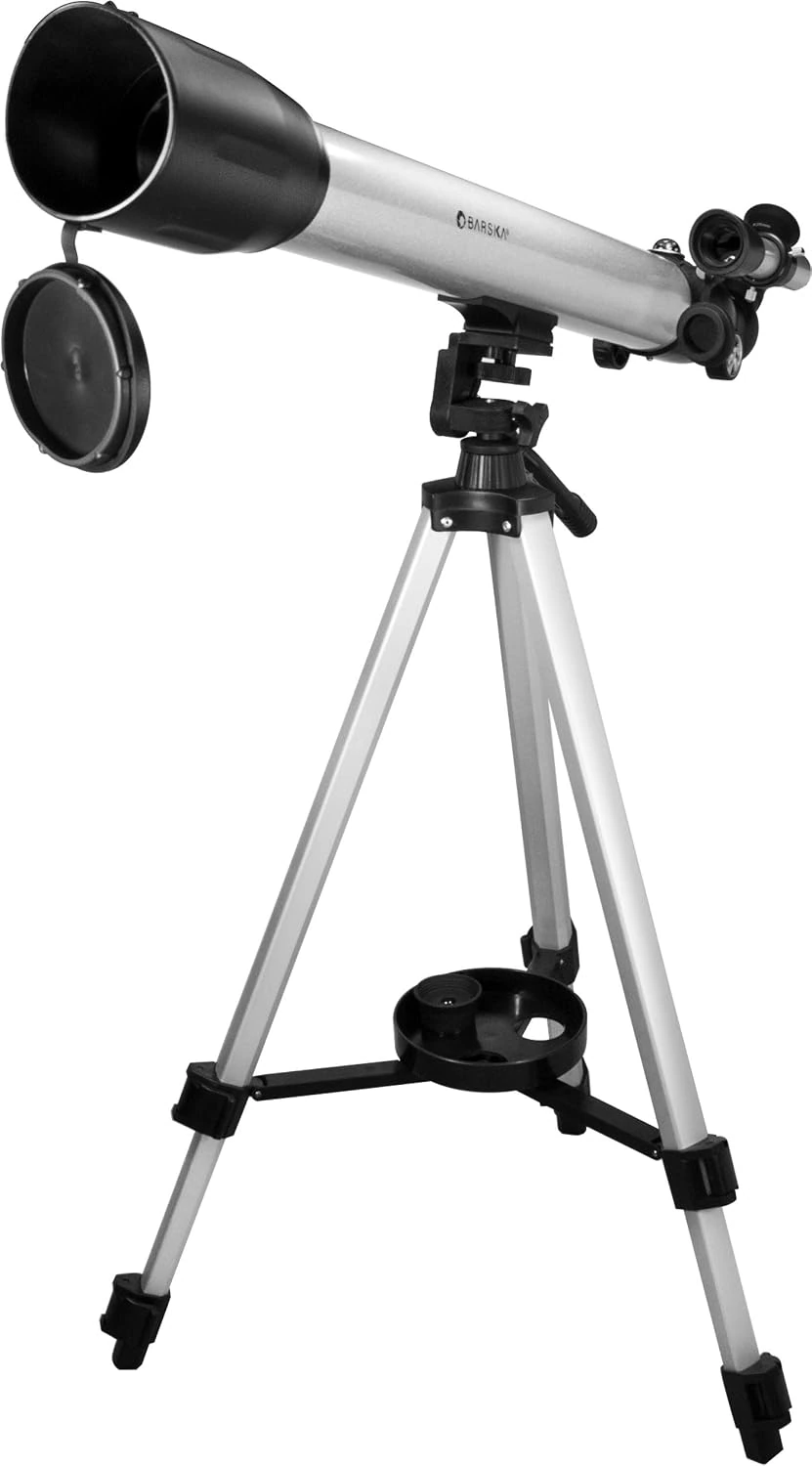
A lightweight 60mm / 700mm Amazon-fulfilled refractor kit with K9 and K25 eyepieces, 3X Barlow lens, pan-head tripod, carrying case, and 10,000-object PC software.
Rounding out our list is the BARSKA 70060 Starwatcher, a classic long-tube 60mm / 700mm refractor on Amazon. It comes with K9 and K25 eyepieces, a 3X Barlow lens, a 5×20 finderscope, a carrying case, and a searchable 10,000-object celestial PC software disc.
With the K25 eyepiece, the 700mm focal length gives comfortable low-power views of the Moon’s surface and bright open clusters.
However, a 60mm objective lens gathers significantly less light than 70mm or 114mm competitors, and the marketed 231X magnification is far too dim and shaky on a lightweight pan-head mount. With no phone adapter or Moon filter included, it is strictly an entry-level pick.
The Bottom Line:
A basic, lightweight starter kit if you specifically want Amazon Prime shipping and a carrying case, though 70mm rivals outperform it easily.
The Good Stuff
700mm focal length offers decent native magnification on the Moon with K25
Includes carrying case, pan-head tripod with tray, and 10,000-object PC software
Lightweight build backed by straightforward Amazon fulfillment
Things to Keep in Mind
60mm objective gathers less light than 70mm and 114mm models above
231X max claim exceeds what a 60mm lens can resolve sharply
Smaller 5×20 finderscope and no phone clip or Moon filter included
Compare optical design, mount hardware, included accessories, and overall scores across all five models:
Model
Brand
Optics / Aperture
Mount & Tripod
Key Extras
User Rating
Score
Grade
AstroPeak 70400
AstroPeak
70mm / 400mm (f/5.7)
Altazimuth + Quick-Flip Tripod
45° Erecting Prism, 5×24 Finder, Carry Bag
4.9 / 5
9.6
A+
AstroView F70076
AstroView
Reflector (Model F70076)
U-Mount Cradle + Micro-Rod
Phone Holder, Moon Filter, IPX4 Body
4.3 / 5
8.4
A-
BORWOLF F40070M
BORWOLF
70mm / 400mm (f/5.7)
Aluminum Tripod (52–140cm)
Phone Clip, Green Moon Filter, Bag
3.9 / 5
7.7
B+
AstroVista 875X
AstroVista
114mm / 700mm Reflector
Aluminum Tripod + Altitude Rod
5×24 Finder, 1.25" Focuser, Sky Guide
3.4 / 5
6.8
B-
BARSKA 70060
BARSKA
60mm / 700mm Refractor
Pan Head Tripod + Tray
Carrying Case, 5×20 Finder, PC Software
3.0 / 5
6.0
C+
Everything to Know Before You Buy
Picking your first (or next) telescope gets much easier once you know which specs actually improve what you see in the eyepiece—and which numbers on the box are mostly noise.
What Actually Matters Under the Night Sky
Aperture Over Zoom
Lens or mirror diameter (70mm–114mm) determines brightness and detail; higher magnification only helps when enough light enters first.
Refractors vs. Reflectors
Refractors are sealed, low-maintenance, and great for day/night use; Newtonian reflectors give bigger aperture but need occasional alignment.
Erecting Prism Comfort
A 45° erecting prism keeps landscapes and lunar edges right-side-up, making aiming far easier for beginners and families.
Solid Tripod Hardware
Quick-flip leg locks, a pan handle, and a center accessory tray dampen vibration and keep spare eyepieces off the wet grass.
Crosshair Finderscope
Aligning a 5×24 finderscope on a distant treetop before dusk saves huge frustration when locating stars in the dark.
Padded Carry Bag
Telescopes with a dedicated padded bag get brought along on road trips and camping weekends far more often than bare tubes.
Pitfalls to Avoid
Chasing “800X” Box Numbers
A practical rule of thumb is roughly 2X per millimeter of aperture; anything past ~140X on a 70mm tube just dims and blurs the image.
Skipping Finderscope Alignment
Always line up your finderscope with the main eyepiece on a distant chimney or pole in daylight before trying to aim at stars.
Starting with High-Power Eyepieces
Always locate your target with the widest eyepiece (25mm or 20mm) first, center it, and only then step up to 10mm or a Barlow lens.
Never Point Near the Sun
Never aim any optical telescope or finderscope at or near the sun without a certified full-aperture solar filter—instant eye damage can occur.
Was this telescope guide helpful?
Join over 3,492 readers who used this comparison to pick their stargazing setup.
Yes, this was helpfulThank you for your feedback!(3,492)(3,493)
Ready for Your Next Clear Night?
Check out our #1 ranked AstroPeak™ 70400 Refractor Telescope — pairing crisp 70mm f/5.7 optics, an upright 45° prism, and a travel-ready padded carry bag.
Owen Gallagher is an amateur astronomy enthusiast and optics reviewer who spends clear evenings testing portable refractors, beginner reflectors, and binoculars away from city glow. His guides focus on real-world ease of setup rather than inflated box specs.